
John James Audubon (1785-1851) lived a tumultuous life riddled with scandal and poverty but his prodigious effort to depict all of America’s birds at life size is today still widely heralded as the standard of wildlife illustration. The monumental Birds of America contains 435 plates depicting 1065 figures of 489 species of American birds, in life size, reproduced from Audubon’s paintings.
Audubon drew largely from specimens gathered in the field or from skins sent to him by naturalists to create his representations. To reproduce his paintings, the images were copied by means of etching on copper plates (often with additional aquatinting and, less frequently, with occasional engraving) and printed in black ink on “double elephant folio” paper by Robert Havell of London (except for plates I-X, which were editioned by W. H. Lizars of Edinburgh). Subsequent to printing, the images were hand colored with watercolor before being distributed, either in installments to subscribers (in eighty-seven parts of five prints each) or as complete bound copies to the general public.
Great-footed Hawk
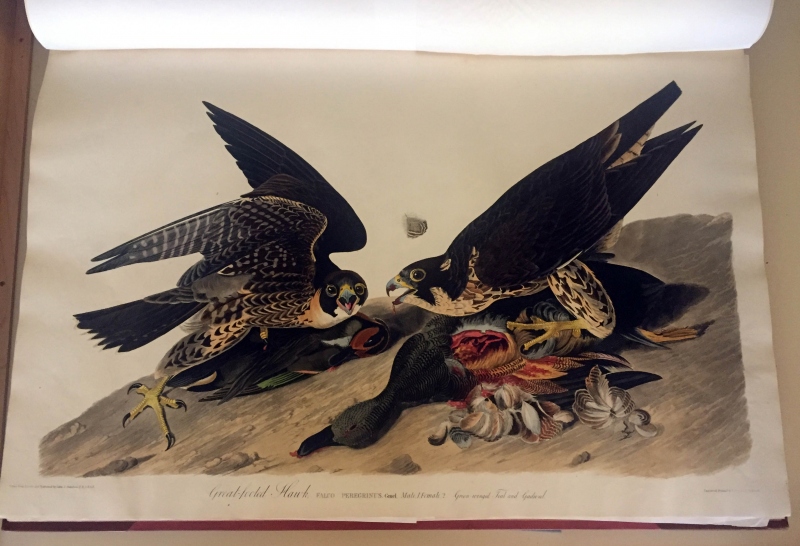
Great-footed Hawk [Peregrine Falcon], Plate XVI
No bird can better illustrate the frequent inaccuracy of the names bestowed by ignorant persons than the present, of which, on referring to the plate, you will see a pair enjoying themselves over a brace of ducks of different species. Very likely, were tame ducks as plentiful on the plantations in our States, as wild ducks are on our rivers, lakes and estuaries, these Hawks might have been named by some of our settlers "Mangeurs de Canards."
Excerpt from Audubon's Ornithological Biography. Edinburgh, 1834-1839.