
John James Audubon (1785-1851) lived a tumultuous life riddled with scandal and poverty but his prodigious effort to depict all of America’s birds at life size is today still widely heralded as the standard of wildlife illustration. The monumental Birds of America contains 435 plates depicting 1065 figures of 489 species of American birds, in life size, reproduced from Audubon’s paintings.
Audubon drew largely from specimens gathered in the field or from skins sent to him by naturalists to create his representations. To reproduce his paintings, the images were copied by means of etching on copper plates (often with additional aquatinting and, less frequently, with occasional engraving) and printed in black ink on “double elephant folio” paper by Robert Havell of London (except for plates I-X, which were editioned by W. H. Lizars of Edinburgh). Subsequent to printing, the images were hand colored with watercolor before being distributed, either in installments to subscribers (in eighty-seven parts of five prints each) or as complete bound copies to the general public.
Prothonotary Warbler
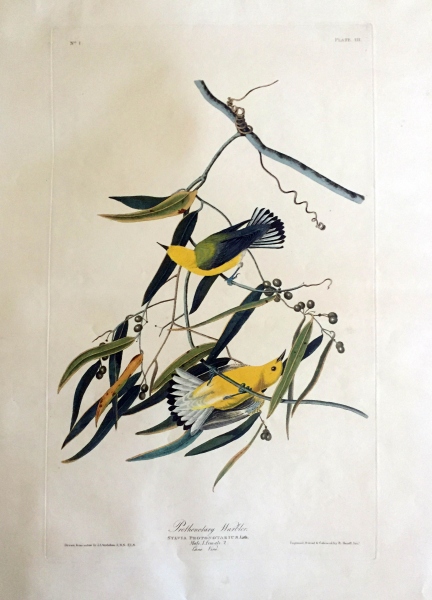
Prothonotary Warbler, Plate III
I never saw this pretty bird in any of our eastern districts, and rarely farther up the Ohio than Louisville, in the neighbourhood of which place it rears its young. [...] On alighting, it moves rapidly along the twigs, partly sidewise, frequently turning about and extending its neck to look under the leaves, from which it picks various kinds of insects.
Excerpt from Audubon's Ornithological Biography. Edinburgh, 1834-1839.